
Asteroid Mining for the Average Person: How Close Are We?
The idea of mining asteroids has moved from science fiction toward serious commercial experimentation. Companies are now building spacecraft specifically designed to reach asteroids, while NASA and other space agencies have demonstrated that spacecraft can rendezvous with, land on, and even return material from asteroids. But there is an enormous difference between being able to reach an asteroid and being able to mine one profitably.
For the average person, the important question is therefore not whether asteroid mining is possible in principle. It is whether it is likely to become an economically useful industry within the next decade or two—and whether an ordinary individual could actually participate in it.
The short answer is: probably not as a consumer business in the near term, but the groundwork for an eventual asteroid-mining economy is being laid now.
The technology is no longer purely theoretical
NASA's OSIRIS-REx mission demonstrated one of the most important pieces of the puzzle. The spacecraft traveled to the near-Earth asteroid Bennu, collected material from its surface, and returned the sample to Earth in 2023. The returned material weighed roughly 0.1 kilograms, and the mission cost about $1.3 billion.
That is an impressive scientific achievement—but it also illustrates the economic problem. Returning a tiny quantity of asteroid material currently requires a multibillion-dollar-scale effort.
NASA's Psyche mission provides another useful demonstration of what we still don't know. Psyche is a metal-rich asteroid in the main asteroid belt, but observations indicate that it may contain a mixture of metal and silicate rather than being a solid ball of precious metals. NASA estimates that metal may constitute roughly 30% to 60% of its volume.
In other words, even identifying an apparently valuable asteroid is not the same as having a proven mineral deposit. We often hear claims that particular asteroids contain trillions of dollars' worth of metals, but those numbers are largely theoretical. The Congressional Research Service notes that such estimates can be highly uncertain because the resources have not been characterized to the standards normally required for a terrestrial mining reserve.
The economics may favor space-based resources first
One of the biggest misconceptions about asteroid mining is that the first profitable business will necessarily involve bringing platinum, gold, or other metals back to Earth.
It may not.
Water could be much more important.
A spacecraft operating in space needs propellant, and propellant is extremely expensive to launch from Earth. If water can be extracted from an asteroid, it can potentially be separated into hydrogen and oxygen and used as rocket fuel. That means the asteroid itself becomes a kind of fuel station.
NASA scientists involved with asteroid exploration have previously identified water as one of the most economically promising resources for asteroid mining.
This leads to a potentially important change in the economics of spaceflight:
Instead of spending enormous amounts of money lifting everything from Earth, future spacecraft could obtain some of what they need after reaching orbit.
That could create an early market for asteroid resources without requiring anyone to ship tons of platinum back to Earth.
The first customers probably won't be ordinary consumers
The near-term asteroid-mining customer is unlikely to be someone buying a piece of asteroid platinum at a jewelry store.
The more plausible customers are:
- satellite operators;
- space agencies;
- launch companies;
- lunar and deep-space missions;
- spacecraft manufacturers;
- governments;
- companies building infrastructure in orbit.
The reason is simple: resources are generally more valuable where they are needed.
A kilogram of water sitting on Earth is cheap. A kilogram of water already positioned in deep space could be extraordinarily valuable because getting it there from Earth requires overcoming Earth's gravity well.
That suggests the first successful asteroid-mining company might look less like a traditional mining company and more like a combination of a logistics company, refinery, robotics company, and spacecraft operator.
Commercial experiments are beginning
The most significant development in 2026 is that private companies are beginning to attempt missions specifically aimed at proving commercial asteroid operations.
AstroForge, for example, says its DeepSpace-2 spacecraft is scheduled for launch in the fourth quarter of 2026. The company plans to send the spacecraft toward a near-Earth asteroid, with the mission intended to demonstrate technologies needed for future resource extraction.
The company's first deep-space spacecraft, Odin, was launched in 2025 but did not provide a straightforward demonstration of asteroid mining. DeepSpace-2 represents a more ambitious attempt to reach and interact with an asteroid.
This is an important distinction. We are entering the demonstration era, not the production era.
The next few missions are essentially experiments designed to answer questions such as:
Can a relatively small spacecraft reliably navigate to an asteroid?
Can it operate autonomously far from Earth?
Can it rendezvous with a small, rapidly moving object?
Can it land on an asteroid whose surface may be radically different from what telescopes suggest?
Can it extract material?
Can it process that material?
And, ultimately, can it do all of this cheaply enough to make money?
We do not yet have affirmative answers to all of those questions.
Asteroids are much harder to mine than they look
Hollywood tends to portray an asteroid as a giant rock floating conveniently in space.
The reality is more complicated.
Bennu, for example, surprised scientists with an unexpectedly rugged surface dominated by large boulders. NASA's analysis published in 2026 emphasized how different the actual surface was from what earlier observations had suggested.
Low gravity creates additional problems. A conventional terrestrial mining technique may not work well when the material you are trying to excavate weighs almost nothing. A drill, excavator, or explosive technique could push the spacecraft away from the asteroid rather than digging into it.
Mining equipment must therefore be extremely lightweight, autonomous, reliable, and capable of operating without human intervention.
Then there is processing.
It is one thing to scoop up rocks. It is another to separate useful metals or extract water, operate a refinery in a vacuum, manage extreme temperatures, and keep machinery functioning for months or years without a technician standing nearby.
What about the average person's ability to participate?
This is where the answer becomes more interesting.
The average person probably will not personally mine an asteroid during the 2020s or early 2030s.
The capital requirements remain enormous, and the technological risks are substantial. Even relatively small deep-space missions require sophisticated spacecraft, launch services, communications systems, navigation, and mission-control infrastructure.
But ordinary people could participate indirectly.
If asteroid mining develops into a genuine industry, it could create investment opportunities, jobs, businesses, and eventually consumer markets. The industry would require engineers, programmers, roboticists, lawyers, insurers, manufacturers, financiers, scientists, communications specialists, and countless other workers.
There is also a more speculative possibility: publicly traded companies could eventually give ordinary investors exposure to the industry.
That should not be confused with saying that asteroid-mining stocks are currently safe investments. At this stage, the technology is sufficiently experimental that an investment can resemble venture capital more than conventional mining investment.
The legal framework is already developing
The United States has already established a legal framework recognizing rights to resources obtained from asteroids and other space resources. Under U.S. law, a U.S. citizen engaged in commercial recovery can possess, own, transport, use, and sell recovered asteroid resources, subject to applicable law and international obligations.
That does not mean that companies can simply claim ownership of an asteroid itself. The legal distinction is between owning the celestial body and obtaining resources from it.
The U.S. framework also calls for commercial space-resource activities to be authorized and continuously supervised by the federal government.
As the industry grows, international rules will become increasingly important.
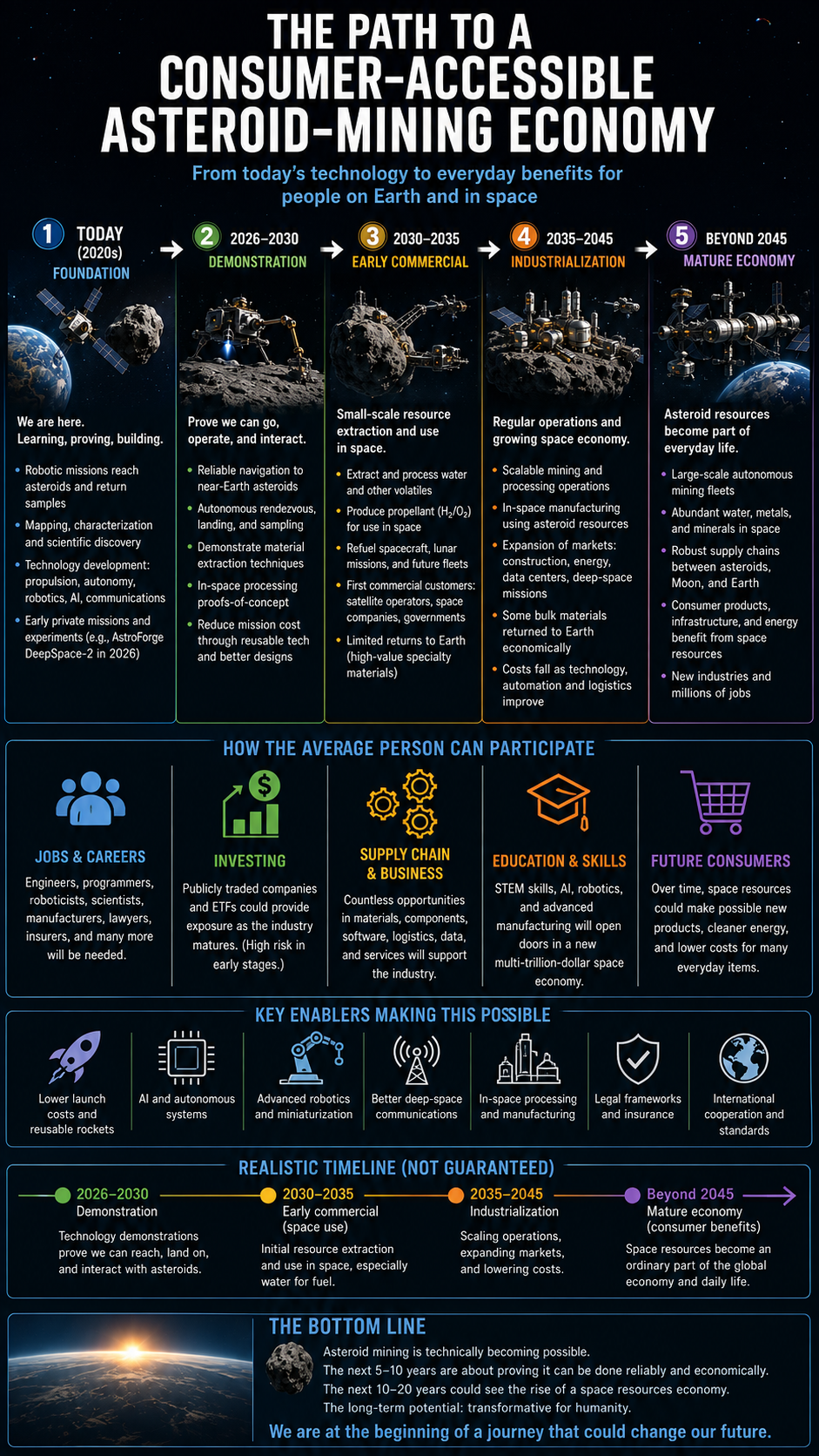
A realistic timeline
A reasonable way to think about asteroid mining is in stages rather than as one dramatic breakthrough.
2026–2030: Demonstration
Private companies attempt increasingly ambitious missions to asteroids. The primary objective is proving navigation, communications, landing, sampling, and perhaps primitive extraction.
2030–2035: Early commercial experiments
If demonstrations succeed, companies could begin attempting small-scale resource extraction. The first economically useful resources are more likely to be used in space than returned to Earth.
2035–2045: Potential industrialization
This is the period in which asteroid resources could begin becoming part of a genuine space economy—assuming launch costs continue falling and the technology proves reliable.
Beyond 2045: Large-scale mining
If the economics work, autonomous fleets could eventually extract substantial quantities of water, metals, and other materials.
These dates are not predictions. They are a way of illustrating the scale of the technological progression required. The Congressional Research Service has cited analyses suggesting that space-based resource markets could emerge before Earth-return mining becomes economically viable; one cited 2021 study projected a potentially significant market for space-derived fuel by 2040 while judging extraction for use on Earth unlikely to be viable before then.
The biggest breakthrough may not be mining
Ironically, asteroid mining could transform the economy before anyone successfully makes a fortune selling asteroid metals.
The technology required to mine an asteroid also requires advances in:
- autonomous robotics;
- artificial intelligence;
- spacecraft propulsion;
- deep-space communications;
- miniature sensors;
- remote manufacturing;
- materials processing;
- orbital transportation;
- reusable launch systems.
Those technologies have applications far beyond mining.
AstroForge itself describes its asteroid missions as a way to develop capabilities that can also support planetary defense, scientific exploration, and other deep-space activities.
That may ultimately be the industry's most important contribution.
So, is asteroid mining feasible for the average person?
Technically, increasingly so. Economically, not yet. Personally, not for quite some time.
The average person is unlikely to buy a mining permit and send a robot to an asteroid in the next several years. But the barrier between science fiction and commercial experimentation is becoming thinner.
The key development to watch is not the discovery of an asteroid supposedly worth $10 quadrillion. It is much more mundane: Can a small spacecraft repeatedly reach an asteroid, operate autonomously, extract something useful, process it, and sell the resulting resource for more money than the entire operation costs?
Once someone demonstrates that cycle reliably, asteroid mining changes from an exotic scientific possibility into an industrial proposition.
And that could eventually make the average person a participant—not because everyone will own a mining robot, but because space resources could become another ordinary component of the global economy.
For now, however, asteroid mining should be viewed as an emerging high-risk technology sector rather than a mature mining industry. The next few years of commercial demonstrations will tell us whether the dream is merely technically possible—or genuinely profitable.