
Phasers: The Star Trek Weapon of Choice
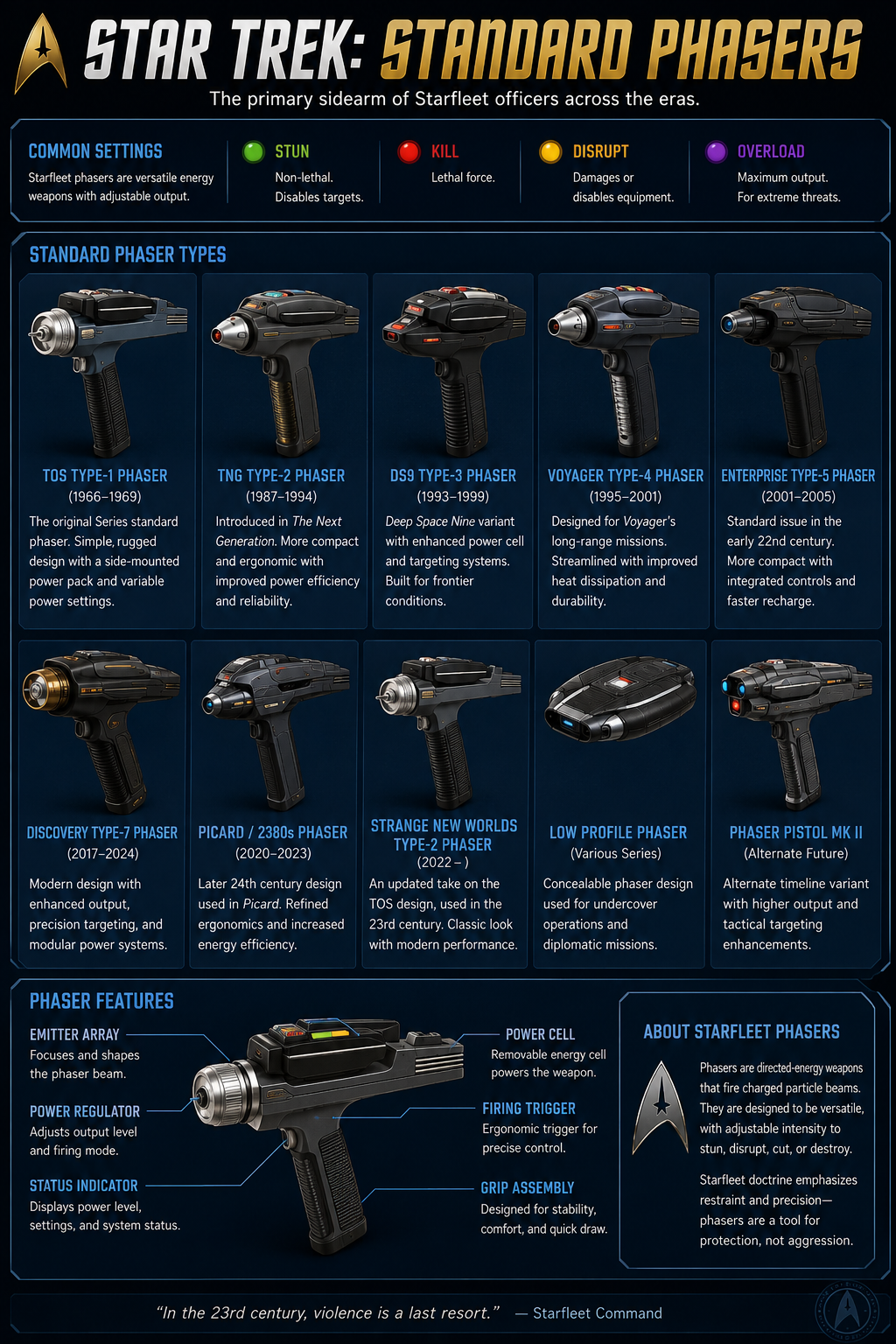 In a typical episode of Star Trek, the phaser is much more than a futuristic pistol. It is the standard sidearm of Starfleet officers, a versatile tool that can be used to stun an opponent, incapacitate a dangerous creature, destroy an object, or, when necessary, deliver enormous destructive power. Its flexibility reflects one of the central ideas of Star Trek: advanced technology is supposed to give its users choices rather than simply making them more violent.
The familiar handheld phaser is usually carried by members of the landing party when a starship crew beams down to an unfamiliar planet or boards another vessel. Because the crew rarely knows what it will encounter, a phaser provides a convenient combination of protection and utility. An officer might carry one while investigating an abandoned facility, negotiating with an alien civilization, or searching for a missing crew member.
The most common setting is the stun setting. Rather than killing an opponent, the phaser releases energy capable of rendering a person unconscious. This is especially important to Starfleet, whose officers generally try to avoid unnecessary killing. During a confrontation with hostile aliens, criminals, or other dangerous individuals, the command is often simple: "Set phasers to stun." A quick blast can end a fight without permanently injuring the opponent.
The stun setting also illustrates the somewhat optimistic technological assumptions of the series. A phaser can incapacitate a person almost instantly while apparently allowing the target to recover later without serious injury. It therefore functions as the science-fiction equivalent of a nonlethal weapon, although the fictional technology is considerably more reliable and powerful than most real-world alternatives.
If a situation becomes more serious, the phaser can be adjusted to a lethal setting. This might occur when the crew is confronted by an enemy that cannot be safely subdued or when an officer's life is in immediate danger. Unlike a conventional firearm, however, the phaser does not simply have one fixed level of power. Its settings can be adjusted to produce dramatically different effects.
One of the phaser's most memorable characteristics is its ability to affect objects as well as living beings. An officer may use a phaser to cut through a door, destroy equipment, heat a substance, or eliminate an obstruction. In some episodes, the weapon is used almost like a futuristic welding or cutting device. This versatility makes the phaser particularly useful when the characters are exploring strange environments where conventional tools may be inadequate.
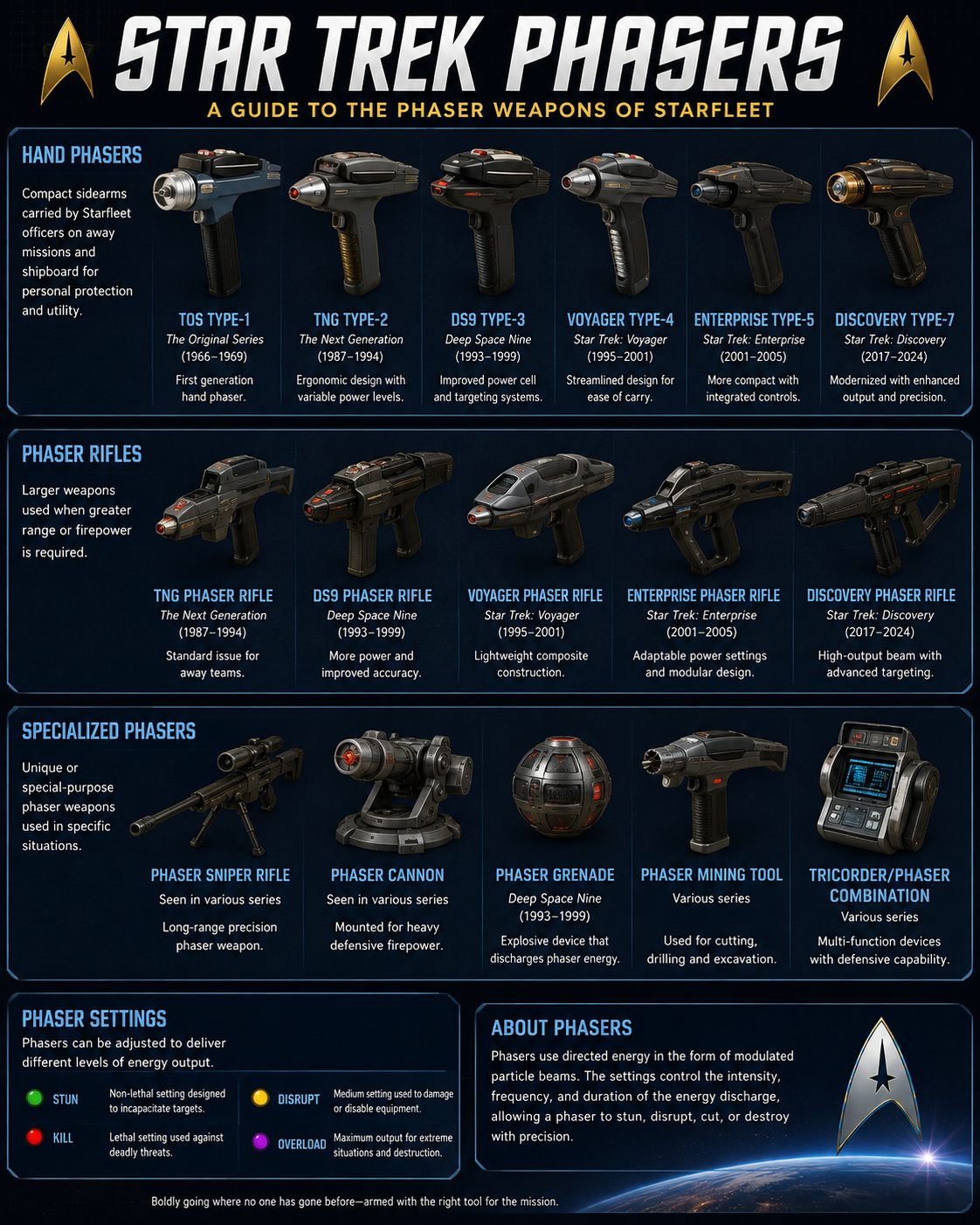 A few generations and types of specialty phasers appearing throughout the series.
The larger phaser rifle provides still greater firepower. It tends to appear when a landing party expects serious resistance or when Starfleet personnel are preparing for a particularly dangerous mission. The rifle is less convenient to carry than the standard hand phaser but is appropriate for situations requiring greater range or power.
Despite their impressive capabilities, phasers are rarely treated as the solution to every problem. A typical Star Trek episode usually begins with the crew attempting diplomacy, investigation, scientific analysis, or some other nonviolent approach. The phaser is there as insurance. When negotiations fail or an unknown threat becomes dangerous, the weapon gives the crew a means of protecting themselves.
This is an important distinction between the phaser and the weapons of many other science-fiction stories. The phaser represents the technological sophistication of the Federation as much as its military strength. Its multiple settings allow an officer to respond proportionally to a situation. A hostile individual can be stunned rather than killed; a locked door can be cut open rather than blown apart; and an overwhelming threat can be met with considerably greater force when necessary.
The phaser also contributes to the visual language of Star Trek. An officer drawing a phaser immediately signals that a situation has become dangerous. The distinctive electronic sound of the weapon firing reinforces the moment, while the changing effects of its energy beam communicate the setting being used. The phaser thus became one of the franchise's most recognizable pieces of technology, alongside the transporter, tricorder, and communicator.
In a typical episode, then, the phaser follows a simple progression: carry it for protection, use the lowest appropriate setting, escalate only when necessary, and employ its unusual capabilities when ordinary tools are insufficient. It is simultaneously a weapon, a tool, and a symbol of Starfleet's preference for restraint.
That combination is perhaps why the phaser remains so closely associated with Star Trek. It embodies the franchise's vision of the future in which technological power is considerable, but the important question is not merely what a device can destroy. It is whether its user has the judgment to decide when—and when not—to use it.