
How to Draw a Square Using a Compass and Straightedge
Drawing a perfect square without a ruler with measurement markings may seem like a challenge, but it is a classic construction problem in Euclidean geometry. With only a compass and an unmarked straightedge, you can construct a square of any chosen side length. The secret is to construct a 90-degree angle and then use the compass to reproduce the same length on the other sides.
What You Need
- A compass
- A straightedge
- Pencil and paper
The straightedge is used only to draw straight lines between points; the compass establishes equal distances and draws arcs.
Step 1: Draw the First Side
Begin by drawing a line segment and label its endpoints A and B.
The segment AB will become one side of the square. Its length can be whatever you choose.
Step 2: Construct a Perpendicular at B
Extend the line through B if necessary. Place the compass point at B and draw an arc that crosses the line on both sides of B. Label the two intersection points F and G.
Now place the compass on G and draw an arc above the line. Without changing the compass opening, place it on F and draw another arc so that the two arcs intersect at a new point H.
Use the straightedge to draw a line from B through H. This line is perpendicular to AB, creating a 90-degree angle at B.
Step 3: Mark Off the Second Side
Set the compass opening to exactly the length of AB. Keep this opening fixed.
Place the compass point at B and make an arc that crosses the perpendicular line. Label that intersection C.
Because the compass opening equals AB, we now know that:
BC = AB
The two adjacent sides therefore have exactly the same length.
Step 4: Locate the Fourth Corner
Keeping the compass set to the same width, place its point at A and draw an arc above the original segment.
Then place the compass point at C and draw another arc so that it intersects the first arc. Label their intersection D.
The construction guarantees that AD, CD, and the existing sides all have the same length.
Step 5: Complete the Square
Finally, use the straightedge to connect:
- A to D
- C to D
You now have quadrilateral ABCD.
Since AB = BC = CD = DA and the angle ABC is 90 degrees, ABCD is a square.
Why Does the Construction Work?
The construction relies on two fundamental geometric ideas.
First, the perpendicular construction guarantees that the angle at B is exactly 90 degrees. A standard compass-and-straightedge perpendicular construction works because equal-radius arcs create points that are equidistant from the endpoints of the original segment.
Second, the compass preserves the side length. Once it has been opened to the length AB, every corresponding arc establishes another point exactly that distance from its center.
Thus:
AB = BC = CD = DA
and
∠ABC = 90°
A quadrilateral with four equal sides and a right angle is a square.
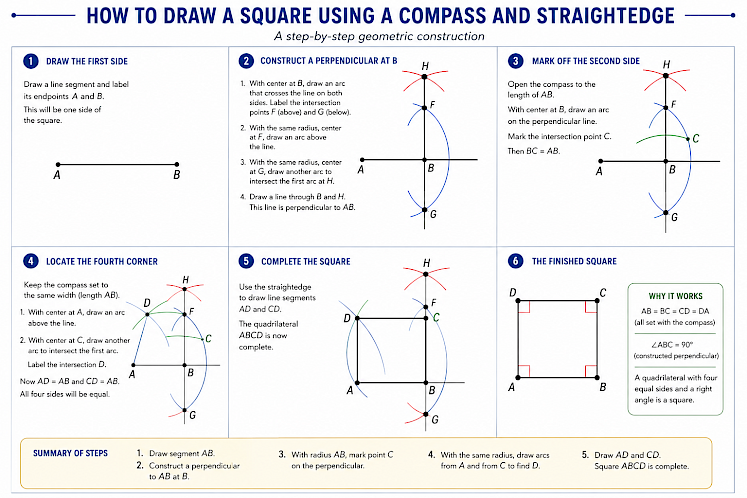
A Classic Example of Geometric Construction
This exercise illustrates an important feature of classical geometry: many figures can be constructed without numerical measurements. Instead of measuring a 90-degree angle or using a ruler to mark off equal lengths, the compass and straightedge establish those relationships geometrically.
The method is closely related to the traditional Euclidean constructions of perpendiculars, perpendicular bisectors, and other geometric figures.
Once mastered, the same techniques can be used to construct rectangles, equilateral triangles, regular polygons, and many other geometric figures.