
Dog Agility Competitions: Speed, Skill, and the Ultimate Dog-and-Handler Partnership
Few dog sports combine athleticism, precision, speed, and teamwork quite like competitive dog agility. In an agility competition, a dog races through a course of jumps, tunnels, weave poles, ramps, and other obstacles while responding to signals from its handler. The goal sounds simple: complete the course correctly and as quickly as possible. In practice, agility demands an extraordinary level of communication between dog and human.
The sport has grown from a small exhibition into a major international canine competition. Dog agility originated in England, where it was introduced as an entertainment event at the 1978 Crufts Dog Show. The demonstration was inspired in part by equestrian show jumping and proved so popular that agility returned to Crufts the following year. In 1980, the UK's Kennel Club formally recognized the sport and began sanctioning competitions.
How an Agility Competition Works
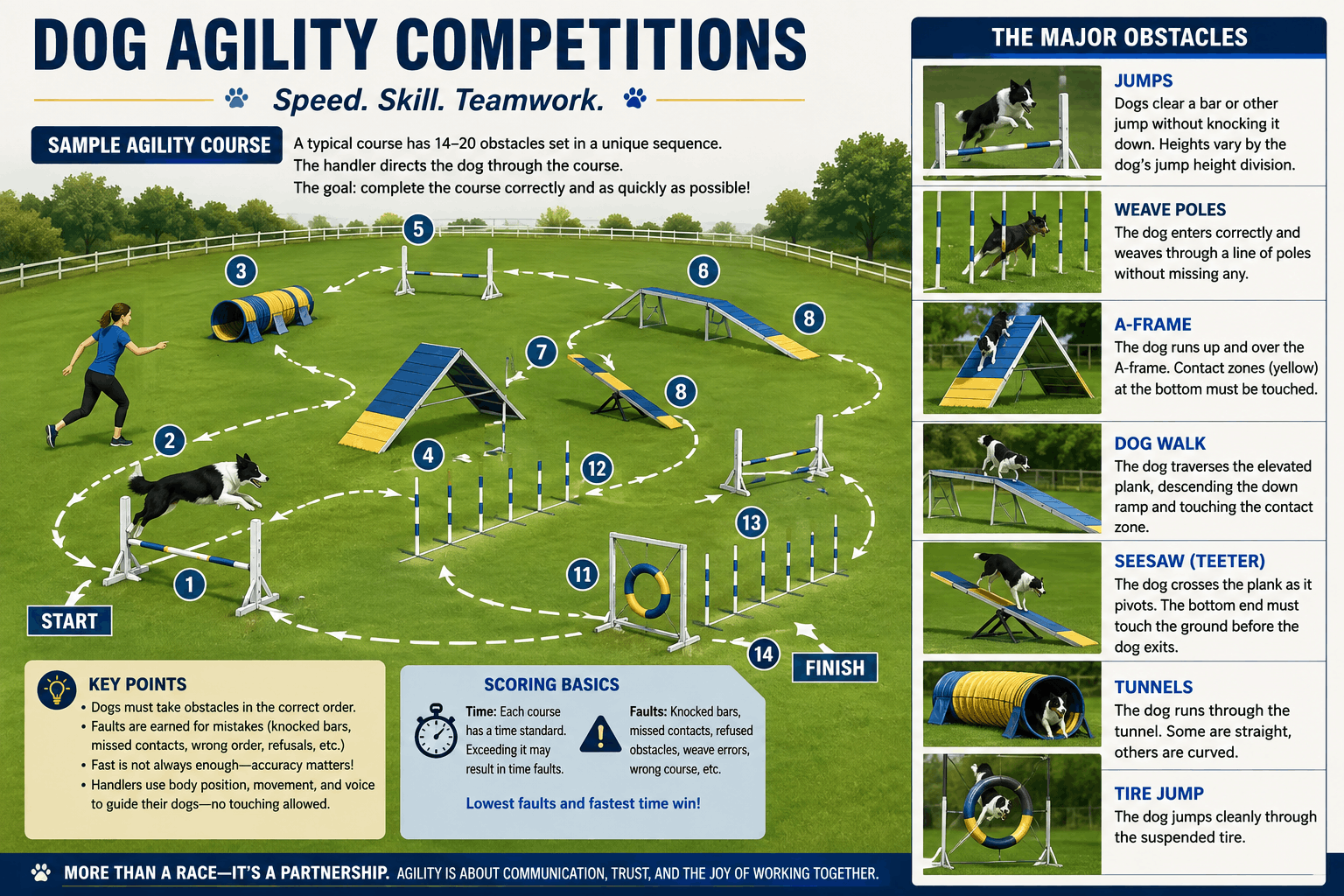
An agility course typically contains roughly 14 to 20 obstacles, although the exact arrangement varies according to the organization, class, and level of competition. Common obstacles include jumps, tunnels, weave poles, the A-frame, dog walk, and seesaw. Dogs must negotiate the obstacles in a prescribed sequence, with the handler directing the dog through the course without physically touching or guiding it.
The course is deliberately designed to test more than raw speed. A fast dog that takes the wrong obstacle, misses a contact zone, skips a weave pole, or knocks down a jump can lose valuable points or be disqualified. A successful competitor therefore needs to find the balance between speed and accuracy.
The handler's role is particularly demanding. Before a run, competitors study the course map and plan their route. During the run, they use body position, movement, voice, and carefully timed signals to tell the dog where to go next. Because the handler cannot simply point out every obstacle from close range, the dog must learn to recognize subtle cues and work independently while remaining connected to its partner.
The Obstacles
Jumps are among the most recognizable elements of agility. Dogs must clear bars or other jump structures without knocking them down. Jump heights are adjusted according to the dog's size, allowing small and large dogs to compete in appropriate divisions.
Weave poles are considerably more technical. The dog must enter correctly and then weave rapidly through a line of poles without missing one. Even highly experienced dogs can lose time or incur faults on this obstacle.
Contact obstacles, including the A-frame, dog walk, and seesaw, require the dog to run up and down elevated equipment while touching designated contact zones. These zones encourage safe, controlled movement and are an important part of competition scoring.
Tunnels test speed and confidence. Some are straight, while others curve so that the dog cannot see the exit when entering. Their apparent simplicity can make them useful training obstacles, but at competition speed they become another element of a highly technical course.
Scoring: Fast Is Not Always Enough
Agility competitions generally combine time and accuracy. Competitors can receive faults for mistakes such as knocking down a jump, refusing an obstacle, entering the weave poles incorrectly, missing a contact zone, or completing obstacles in the wrong order. Depending on the rules and level, enough faults can result in elimination or disqualification.
Course times are also important. Each course has a designated time standard, and exceeding the allowed time can result in additional penalties. At the highest levels, a fraction of a second can separate successful competitors from the rest of the field.
Different organizations use somewhat different scoring systems and classes. The American Kennel Club, for example, offers Standard, Jumpers With Weaves, FAST, and other classes at progressively more challenging levels. USDAA competitions include Standard Agility as well as specialized events such as Steeplechase, Gamblers, Snooker, and team competitions.
Dogs of All Shapes and Sizes
One of agility's greatest attractions is its inclusiveness. Competition organizations divide dogs into jump-height categories so that smaller dogs are not required to clear the same jumps as much larger dogs. This allows an enormous variety of breeds to participate, from tiny terriers and toy breeds to larger sporting and herding dogs. Mixed-breed dogs can also compete in many modern agility programs.
Border Collies are particularly prominent in elite agility because of their speed, responsiveness, athleticism, and ability to learn complex sequences. But success is not limited to one breed. A confident, physically capable dog with good concentration and a strong desire to work with its handler can become an accomplished agility competitor.
Training for Competition
Competitive agility begins long before a dog enters the ring. Dogs must first learn individual obstacles and basic skills before they can safely combine them into sequences. Training also develops what is often called obstacle commitment: the ability to continue toward the intended obstacle even when the handler is moving in another direction.
Handlers must train themselves as well. They learn course-reading, timing, positioning, and different handling techniques. The most successful partnerships appear almost effortless because the dog has learned to interpret the handler's movements almost instantly.
Training should also take physical conditioning and safety seriously. Agility involves jumping, rapid acceleration, sharp turns, climbing, and sudden changes of direction. Dogs need appropriate conditioning, surfaces, equipment, and recovery time, particularly as the demands of competition increase.
From Local Trials to World Championships
Agility has developed into an international sport with numerous organizations, championships, and competitive formats. In the United States, the American Kennel Club held its first licensed agility trial in Houston in 1994. USDAA, founded in 1986, helped establish organized competition in North America and launched its Grand Prix of Dog Agility tournament in 1988.
USDAA's modern tournament structure includes individual and team competitions, with qualifying events leading toward major championship events. Its Cynosport World Games, for example, brings competitors from countries around the world.
International competitions have helped transform agility from a novelty into a serious canine sport. Elite competitors can spend years developing the speed, precision, and communication necessary to compete at the highest level.
More Than a Race
What makes dog agility compelling is that the dog is not simply running an obstacle course. The handler and dog are performing together, often at remarkable speed. A handler may have only seconds to communicate a sequence of obstacles, while the dog must interpret those signals, make decisions, maintain balance, and execute each obstacle accurately.
That partnership is the heart of the sport. The stopwatch provides the competitive tension, but the real spectacle is the communication between two very different species moving as a single team.
For spectators, agility can be thrilling even without an understanding of every rule. For competitors, it offers a lifelong progression of training, titles, challenges, and shared accomplishments. And for the dogs themselves, it provides an opportunity to use their intelligence, athletic ability, confidence, and enthusiasm in a structured activity with their human partner.
From its beginnings as a 1978 entertainment feature at Crufts to today's international championships, dog agility has evolved into one of the most dynamic and accessible dog sports in the world. Its appeal is ultimately simple: a dog, a handler, a course, and a few exhilarating seconds in which everything has to go exactly right.